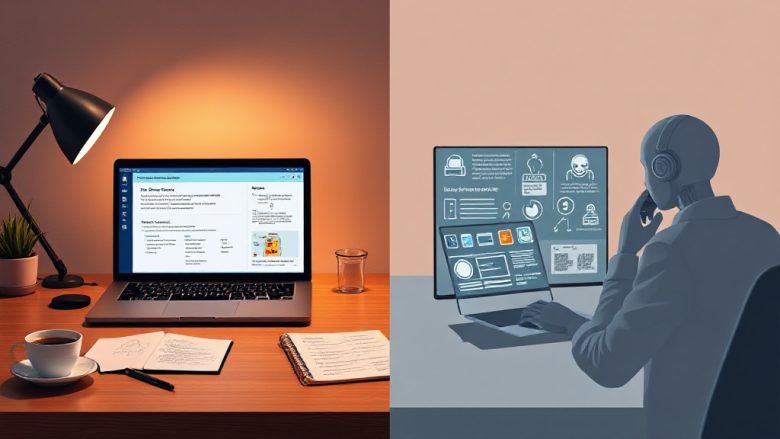
You’re typing a reply to a colleague when your email app offers a suggested sentence. It’s eerily close to what you were about to write. Is that a small miracle of convenience or the first step toward a world where you don’t write your own thoughts anymore? That split reaction is exactly why a plain-English look at artificial intelligence pros and cons explained matters. AI is already woven into search results, photo apps, customer service chats, and medical scans. The question isn’t whether it’s good or bad in the abstract. It’s where it helps, where it hurts, and how to tell the difference.
This article walks through both sides with real examples, then offers a simple way to weigh them for your own life and work. No hype, no doom. Just an honest map.
What Artificial Intelligence Actually Does
Before judging the pros and cons, it helps to know what we’re talking about. Most AI people encounter today is narrow: it’s trained to do one family of tasks well. A recommendation engine predicts what video you’ll watch next. A language model predicts the next word in a sentence. A vision system predicts whether a scan shows a tumor. None of these systems understands meaning the way a person does. They find patterns in enormous amounts of data and apply those patterns to new situations.
That pattern-matching is why AI can feel magical and clumsy in the same afternoon. It can summarize a 40-page report in seconds, then confidently state a fact that’s wrong. It can translate a menu flawlessly, then fail to grasp a sarcastic joke. Once you see AI as a very fast pattern finder rather than a thinking being, the pros and cons become easier to separate.
The Strongest Pros of Artificial Intelligence
The clearest win is speed at scale. Tasks that once took a team hours now take a single person minutes. A paralegal can search thousands of contracts for a specific clause. A small business owner can draft product descriptions for 200 items in an afternoon. A radiologist can get a second opinion on an image before the patient leaves the room. The value isn’t that AI is smarter than the professional. It’s that it handles the repetitive middle layer so the professional can focus on judgment.
Accessibility is another underrated benefit. Real-time transcription helps deaf and hard-of-hearing users follow conversations. Text-to-speech gives a voice to people who have lost one. Translation tools let a traveler ask for directions in a language they’ve never studied. These aren’t fringe cases. They’re daily improvements in quality of life that would have seemed futuristic a decade ago.
AI also shines in environments that are dangerous or dull for humans. It monitors factory equipment for signs of failure. It routes delivery trucks to save fuel. It scans satellite imagery for illegal logging. In each case, the machine doesn’t get bored, tired, or distracted. That reliability is a genuine advantage when the cost of a missed signal is high.
Finally, AI can surface patterns humans miss. In medicine, it has flagged subtle indicators in retinal scans that trained eyes overlooked. In climate science, it has helped identify weather patterns hidden in decades of data. The machine isn’t creative, but it can be a very patient assistant.
The Real Cons of Artificial Intelligence
Bias is the first problem most people notice once they look closely. AI learns from historical data, and historical data carries historical prejudice. A hiring tool trained on past decisions may quietly favor one demographic. A facial recognition system may work better on some skin tones than others. The bias isn’t added on purpose; it’s inherited. Fixing it requires deliberate auditing, diverse training data, and human oversight that many organizations skip because it’s expensive.
Then there’s the accuracy problem. Large language models are designed to produce plausible text, not verified truth. They can invent citations, misstate dates, and blend two real events into one fictional one. For a casual chat, that’s annoying. For a legal brief, a medical summary, or a financial report, it’s dangerous. The fix is simple in principle and hard in practice: verify anything that matters.
Job displacement is the con that generates the most anxiety, and it deserves a nuanced answer. AI rarely eliminates an entire occupation overnight. It tends to automate specific tasks within a role. A customer service agent may spend less time on password resets and more time on complex complaints. A junior designer may spend less time resizing images and more time on concept work. The disruption is real, but it’s uneven. Workers whose jobs are mostly routine and digital face the sharpest risk. Workers whose jobs require physical dexterity, emotional nuance, or creative judgment have more breathing room, at least for now.
Privacy is another legitimate concern. AI systems often need data to improve, and that data frequently comes from users. Every photo you upload, every message you type, every search you run can become training material unless you opt out. Many people don’t realize how much they’re sharing until they read a policy they never opened. The trade-off between convenience and confidentiality is real, and it’s usually tilted toward the company, not the user.
There’s also the environmental cost. Training large models consumes significant electricity and water for cooling. Inference, the act of running the model for each user query, adds up across millions of daily interactions. The footprint isn’t as visible as a factory smokestack, but it’s growing. Companies are investing in more efficient hardware and renewable energy, yet the scale of the problem keeps expanding.
How to Weigh the Pros and Cons for Yourself
Abstract debates about AI rarely help. A more useful approach is to ask three questions about any specific use you’re considering.
First, what’s the cost of an error? If AI suggests a movie and it’s wrong, you lose two hours. If AI suggests a medication dose and it’s wrong, someone gets hurt. The higher the stakes, the more human review you need. Low-stakes tasks are where AI shines with the least risk.
Second, who benefits and who bears the risk? If a company uses AI to speed up hiring but the candidate bears the risk of a biased rejection, that’s a problem. If a hospital uses AI to flag early disease and the patient benefits from earlier treatment, that’s a different equation. The technology is the same; the distribution of benefit and harm is not.
Third, can you explain the decision? If an AI system denies a loan or rejects an insurance claim, the person affected deserves a reason. Systems that can’t provide one create a power imbalance. Systems that can be audited and challenged are more trustworthy, even if they’re not perfect.
A short list can help here. Before adopting any AI tool, ask: Is the task repetitive? Is the data clean and representative? Is there a human check before consequences land? If the answer to any of these is no, slow down.
Frequently Asked Questions About AI Pros and Cons
Is artificial intelligence more helpful or more harmful overall?
It depends on the use case. For repetitive, low-stakes tasks with human oversight, AI is clearly helpful. For high-stakes decisions without transparency or review, it can cause real harm. The technology itself is neutral; the context determines the outcome.
Will AI take my job?
It may take over parts of your job, especially routine digital tasks. Roles that require physical skill, emotional intelligence, or creative judgment are less exposed in the near term. The practical move is to learn how to work alongside AI tools rather than compete with them directly.
Can I use AI without giving up my privacy?
Sometimes. Read the settings and policies of any tool you use. Many services let you opt out of data training. For sensitive information, avoid pasting it into a chatbot unless you’re certain how it’s stored and used. When in doubt, treat AI inputs like public posts.
The Takeaway
Artificial intelligence isn’t a single force with a single verdict. It’s a set of tools that amplify whatever they’re pointed at. Pointed at repetitive work with a human checking the output, it saves time and reduces drudgery. Pointed at high-stakes decisions without accountability, it can quietly reinforce old biases and new mistakes. The honest position isn’t pro-AI or anti-AI. It’s pro-clarity. Know what the tool does, know what it costs, and know who’s responsible when it’s wrong. That’s how you get the benefits without pretending the risks don’t exist.